
Deel Alternatives 2026: The Brutal Truth About Switching Your Global Payroll
If you are furiously googling for Deel alternatives in 2026, you are probably staring at a massive, infuriating invoice for Employer of Record fees.
I get it, paying a massive premium just to legally hire someone in another country feels like you are being extorted by a tech company.
You want to find Deel alternatives that magically offer the exact same global compliance network for a fraction of the price.
But before you pull the plug and try to migrate your entire global workforce to a cheaper platform, we need to have a very serious conversation about the brutal reality of switching.
This is not going to be a sugarcoated listicle of Deel alternatives that just parrots the marketing copy from their competitors.
I am going to tear down the entire landscape of Deel alternatives and expose exactly what you are sacrificing when you try to save a few bucks on international payroll.
Because when you are dealing with cross-border employment laws, cheap software is usually just a very expensive lawsuit waiting to happen.
There are definitely legitimate Deel alternatives on the market that might fit your specific use case, but you have to know exactly what you are walking away from.
If you are easily offended by the truth, or if you think managing global HR is as simple as sending a PayPal transfer, you should probably stop reading right now.
But if you want to protect your business from devastating compliance audits while genuinely exploring Deel alternatives, pay very close attention.
Before we dive deep, if you are just frustrated by a bad customer support ticket and want to stick with the undisputed king of global hiring, you can check out Deel’s latest features right here.
Table of Contents
Evaluating Deel Alternatives: Global Compliance & Features
When you start evaluating Deel alternatives, the first thing you have to look at is the raw scale of their compliance engine.
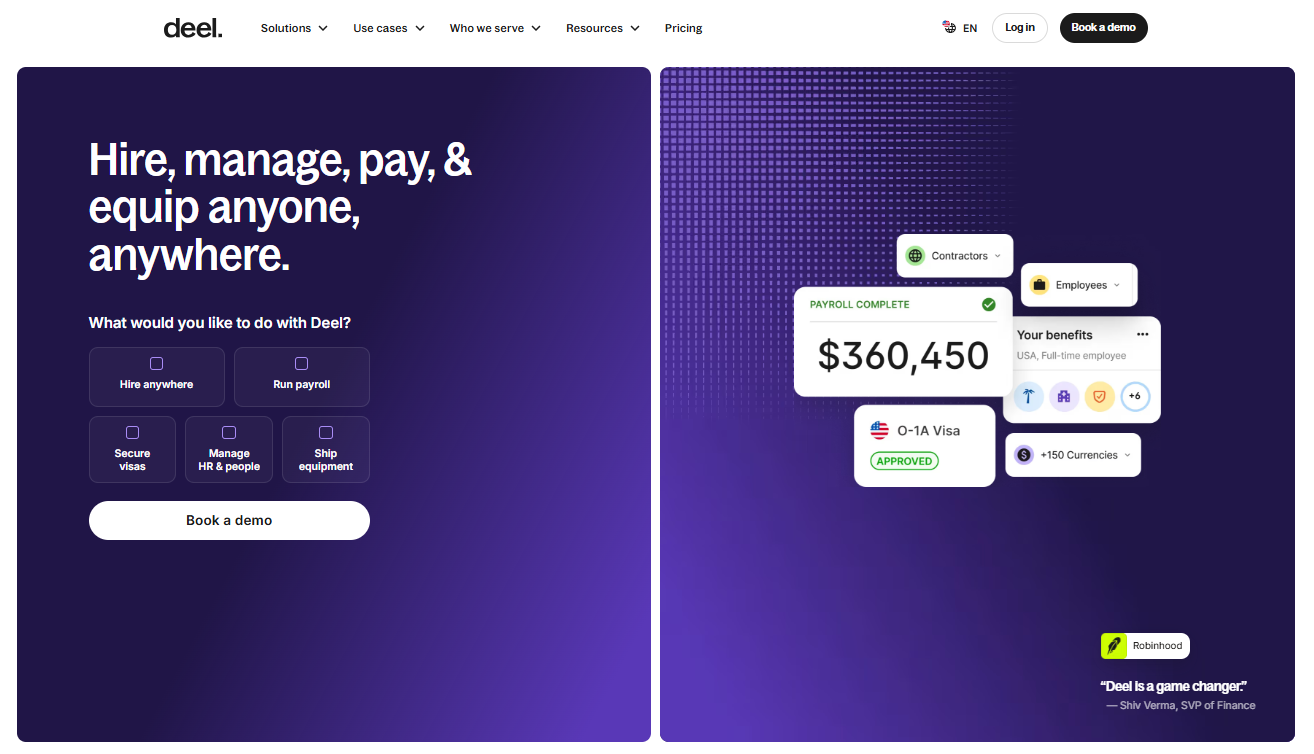
The reason you are paying them so much money is because they have spent years and millions of dollars setting up legal entities in over 150 countries.
Most of the flashy new Deel alternatives simply do not have that kind of proprietary infrastructure built out yet.
Instead, many of these cheaper Deel alternatives rely on third-party partners to handle the actual Employer of Record duties in obscure countries.
This means when something goes wrong with a localized contract, your cheaper platform has to submit a ticket to their partner, adding layers of bureaucratic delay.
When you are exploring Deel alternatives, you must demand absolute transparency on whether they own their local entities or if they are just white-labeling someone else’s legal framework.
If they do not own the entity, you are essentially paying a software company to play a high-stakes game of telephone with foreign tax authorities.
Another massive feature you have to compare when looking at Deel alternatives is the automated collection of tax documents like the W-8BEN.
A lot of the budget Deel alternatives simply expect you to manually track and store these documents, which completely defeats the purpose of buying HR software.
You also have to scrutinize the misclassification risk assessment tools that the top Deel alternatives claim to offer.
If a platform does not actively warn you when a contractor is starting to look legally like a full-time employee, they are setting you up for a massive audit.
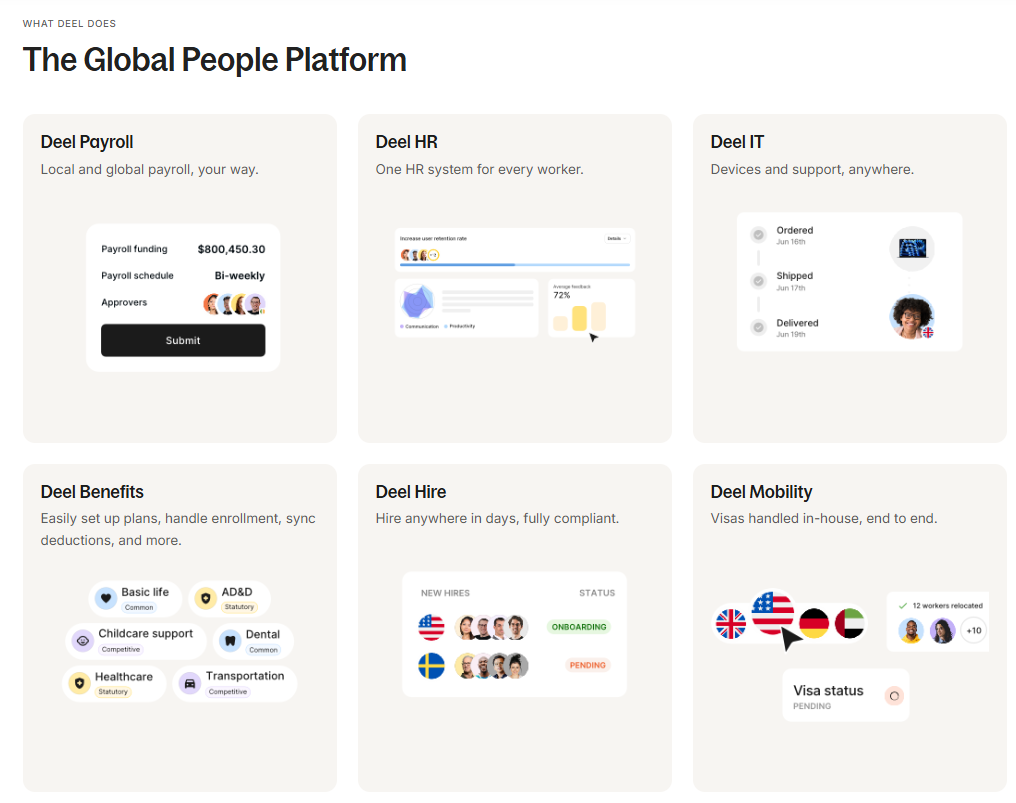
The reality is that very few Deel alternatives can match the sheer breadth of automated compliance features that the market leader provides.
You might save a hundred dollars a month on base fees with these Deel alternatives, but you will pay for it in administrative headaches and increased legal exposure.
Deel Alternatives: Pros and Cons
Let us break down the raw, unfiltered reality of migrating away from the market leader to one of the emerging Deel alternatives.
You need to look past the aggressive sales pitches from these Deel alternatives and focus on the actual mechanics of running global payroll.
Pros of Switching to Deel Alternatives:
- The most obvious benefit of exploring Deel alternatives is the potential for significantly lower base fees for Employer of Record (EOR) services.
- Many newer Deel alternatives offer a much more transparent, flat-rate pricing model that doesn’t rely on hidden exchange rate markups.
- You might actually get personalized, human customer support from smaller Deel alternatives that are desperately trying to win your business.
- Some Deel alternatives are highly specialized in specific regions, offering much better benefits packages in places like Europe or Latin America.
- A few emerging Deel alternatives do not aggressively push annoying upsells like misclassification insurance down your throat every time you log in.
- If you are only hiring independent contractors, you can find incredibly cheap Deel alternatives that just focus on moving money without the heavy EOR bloat.
- Smaller Deel alternatives often have much faster feature iteration cycles, meaning they might build custom integrations for your specific tech stack.
Cons of Switching to Deel Alternatives:
- The vast majority of Deel alternatives simply do not support as many countries natively, severely limiting your future hiring pool.
- Migrating your existing team to any of the Deel alternatives requires terminating contracts and forcing your employees to undergo a terrifying off-boarding and on-boarding process.
- Many budget Deel alternatives lack the robust API infrastructure needed to integrate seamlessly with your existing accounting software.
- You are taking a massive risk on the long-term viability of newer Deel alternatives; if they run out of venture capital, your payroll freezes.
- The user interface of cheaper Deel alternatives is often clunky, buggy, and confusing for your contractors to navigate.
- Some Deel alternatives heavily restrict the withdrawal methods available to contractors, completely eliminating popular options like cryptocurrency.
- When you use unproven Deel alternatives, you are essentially beta-testing their international legal compliance with your company’s reputation on the line.
Are Deel Alternatives For You?
This is the critical question you must answer before you initiate a catastrophic migration to one of the many Deel alternatives.
If you are a bootstrapped founder who is just starting to hire a few independent freelancers, you absolutely should be using Deel alternatives.
You do not need an enterprise-grade compliance fortress just to send a few hundred dollars a month to a graphic designer.
There are incredibly lean Deel alternatives that focus purely on facilitating cheap cross-border wire transfers without the massive EOR overhead.
However, if you just raised a massive funding round and you need to scale an engineering team across ten different time zones, cheap Deel alternatives will destroy you.
When you are dealing with that level of global complexity, the risk of a misclassification lawsuit becomes an existential threat to your entire business.
Deel is built to mitigate that exact existential threat, and their pricing reflects the massive legal shield they provide.
If your core business strategy relies on hiring the absolute best talent in the world regardless of geography, you cannot afford to mess around with untested Deel alternatives.
You have to decide if the thousands of dollars you save by switching to Deel alternatives is worth the sheer terror of an international tax audit.
If your company can easily absorb the premium fees of the market leader, you should stop looking for Deel alternatives and just focus on growing your business.
But if seeing that massive monthly invoice genuinely threatens your runway, you have no choice but to deeply investigate the more transparent Deel alternatives on the market.
Getting Started with Deel Alternatives
If you have made the bold decision to migrate to one of the major Deel alternatives, the setup process is going to require immense operational discipline.
Unlike starting fresh, moving an existing team to any of the Deel alternatives is a highly sensitive HR operation that can easily trigger a mass exodus of your top talent.
You cannot simply flip a switch and expect all of your international contractors to magically appear in the new dashboard of your chosen Deel alternatives.
You have to systematically terminate their existing agreements on the old platform and simultaneously issue new contracts through the chosen Deel alternatives.
This means your employees will have to go through the entire annoying onboarding process again, uploading their passports and tax forms to the new Deel alternatives.
You must over-communicate with your team during this transition, assuring them that the new Deel alternatives will not delay their upcoming paychecks.
Once the team is theoretically onboarded to one of the Deel alternatives, you need to run a parallel payroll test to ensure the banking pipelines actually work.
Because if the cheaper Deel alternatives fail to route the money correctly on the first of the month, your team will immediately lose faith in your leadership.
The onboarding flows of the top Deel alternatives are generally getting better, but they rarely match the frictionless perfection of the market leader.
You must be prepared to manually hold the hands of your contractors as they navigate the slightly clunkier interfaces of these Deel alternatives.
If you survive the migration process without losing any key engineers, the cheaper Deel alternatives can finally start saving you money.
In-Depth Payroll Breakdown of Deel Alternatives
Now let us talk about the actual mechanics of moving money, because this is where many Deel alternatives quietly hide their own exorbitant fees.
You might migrate to one of the cheaper Deel alternatives specifically to avoid hidden exchange rate markups, only to find they charge massive SWIFT transfer fees instead.
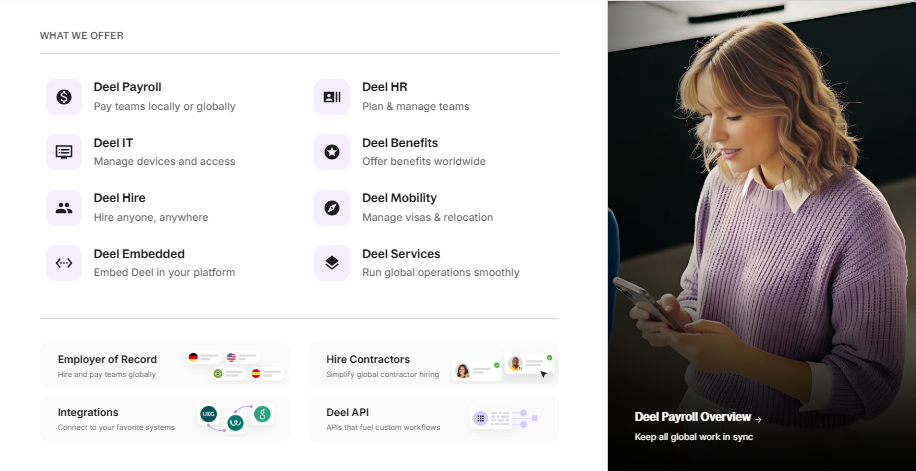
When you run payroll on the top Deel alternatives, the system aggregates all of your active contracts into a single massive invoice just like the market leader.
You fund that invoice in your base currency, and the Deel alternatives attempt to route that money to dozens of different local banking systems.
This is the exact moment where the infrastructural weakness of cheaper Deel alternatives becomes painfully obvious.
Because they do not have the massive volume of the market leader, many Deel alternatives cannot secure the best wholesale exchange rates from banking partners.
This means your contractors might actually receive less local currency when you use budget Deel alternatives, entirely defeating the purpose of switching to save money.
You must demand absolute transparency on exchange rate spreads before you commit your payroll to any of these Deel alternatives.
Furthermore, many Deel alternatives severely restrict how your contractors can actually withdraw their hard-earned money.
While the market leader offers PayPal, Payoneer, and crypto withdrawals, many Deel alternatives force your team to accept slow, traditional bank wires.
If a payment gets flagged by a correspondent bank, you will quickly discover whether the customer support of your chosen Deel alternatives is actually better.
Often, the smaller Deel alternatives have completely overwhelmed support teams that cannot resolve complex international banking errors any faster than the giant you just left.
You are trading one set of frustrations for another when you migrate to Deel alternatives, and you must meticulously calculate if the lower base fees actually offset the hidden transactional friction.
Pricing Plans of Deel Alternatives
This is the section where we expose exactly how the pricing models of the top Deel alternatives actually stack up against the market leader.
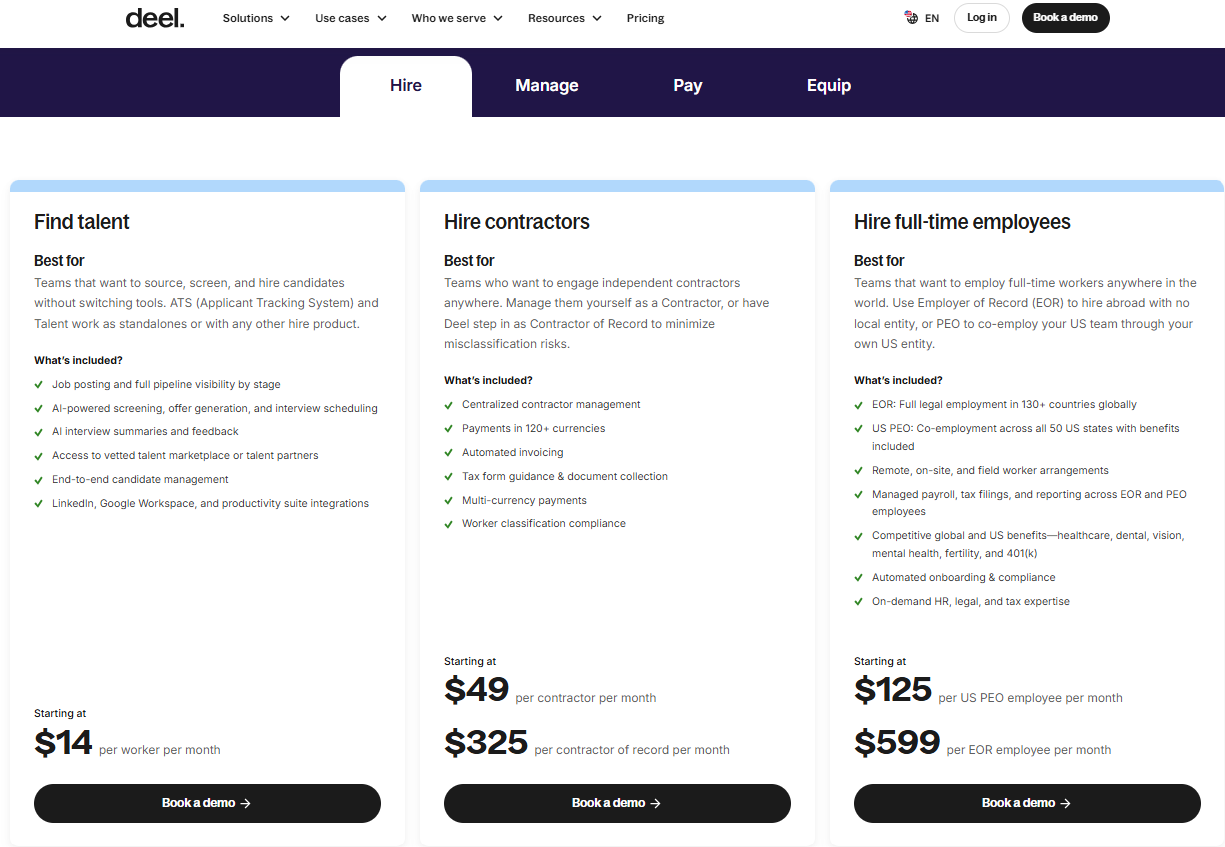
If you are just hiring independent contractors, many Deel alternatives offer base fees that are significantly lower than the standard forty-nine dollars a month.
You can easily find lean Deel alternatives that charge as little as twenty dollars a month per contractor, which is incredibly appealing for large freelance pools.
But the true financial battleground for Deel alternatives is in the Employer of Record (EOR) pricing, where the market leader charges an astronomical six hundred dollars a month.
This is where aggressive Deel alternatives like Remote.com and OysterHR attempt to aggressively undercut the market with massive discounts for enterprise commitments.
Some Deel alternatives advertise EOR rates that are literally half the price of the market leader, promising the exact same level of global compliance.
But you have to read the fine print of these Deel alternatives very carefully, because they often charge additional fees for mandatory localized benefits or complex off-boarding procedures.
When you use extremely cheap Deel alternatives, you are fundamentally betting that their leaner operational model will not compromise their legal rigor when the local tax authorities come knocking.
You must also heavily scrutinize the exchange rate markups embedded within the pricing structures of all Deel alternatives.
A platform might boast the lowest EOR base fee in the industry, but if their Deel alternatives quietly skim three percent off every currency conversion, you are losing massive amounts of money.
Do not be blinded by the low subscription costs heavily advertised by the marketing departments of these Deel alternatives.
You must build a comprehensive spreadsheet modeling the total cost of ownership, including base fees, exchange spreads, and withdrawal costs, before you declare any of the Deel alternatives a definitive financial victory.
Final Conclusion: Are Deel Alternatives Worth It?
The final verdict on migrating to Deel alternatives is incredibly nuanced, and it depends entirely on your operational maturity and your tolerance for risk.
There is a massive, thriving ecosystem of Deel alternatives that are genuinely trying to disrupt the exorbitant pricing model of global payroll.
If you are a highly cost-conscious business that is willing to trade a slightly clunkier UI and fewer country options for massive monthly savings, you absolutely must explore Deel alternatives.
The sheer amount of money you can save on EOR base fees by switching to aggressive Deel alternatives is too massive to ignore.
However, if you have venture funding and your only objective is to scale a global team flawlessly and instantly, migrating to Deel alternatives is a dangerous distraction.
The market leader has solved the terrifying problem of global compliance better than almost any of the Deel alternatives currently on the market.
If you value absolute speed, an unparalleled network of owned entities, and a frictionless experience for your highly paid engineers, you should probably just stick with Deel.
It is an incredibly expensive tool, but for the fastest-growing companies on earth, the peace of mind it provides easily outweighs the discount offered by unproven Deel alternatives.
Use the cheaper Deel alternatives if your profit margins are razor-thin, but be fully prepared for the massive administrative friction that comes with using a challenger brand.
Top 3 Deel Alternatives to Consider
If you have read this entire brutal teardown and you are still absolutely determined to migrate away, here are the top Deel alternatives you must evaluate.
First, you must look at Remote.com, which is widely considered one of the most formidable Deel alternatives due to their incredibly transparent, flat-rate pricing model.
Remote owns their own entities in many countries, making them one of the few Deel alternatives that can genuinely compete on speed and raw compliance rigor.
OysterHR is another massive player in the space of Deel alternatives, particularly if you are heavily focused on providing extremely competitive, localized benefits packages to attract senior talent.
Finally, if your hiring is strictly confined within the borders of the United States, Gusto is vastly superior to almost all global Deel alternatives for domestic payroll processing.
If you just want to send cheap international payments to independent freelancers without any of the heavy compliance software bloat, tools like Wise or Payoneer are excellent Deel alternatives.
But remember, if you choose the absolute cheapest Deel alternatives on the market, you are taking on 100% of the legal liability if a foreign government decides you are misclassifying your workforce.
Choose your Deel alternatives wisely, because migrating global payroll providers is a fresh level of hell you only want to experience once in your career.
